German steel · Ice-hardened · Finished by hand
Great efforts.
Effortless cuts.
Every MAD SHARK blade leaves the grinder the slow way: German high-carbon steel, ice quenching for hardness, and an edge a person — not a machine — brings to 15 degrees a side. Then it goes to work in your kitchen for years.
Browse the knivesThe range
Five families, one grind philosophy. Start with the job, not with the knife.
Featured
The blades and tools our customers rate in the thousands — the proven core of the line.
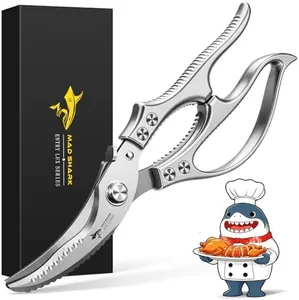
Heavy Duty Poultry Shears
Spring-loaded poultry shears with 3.5 mm tempered blades, a 0.2-second thumb lock and a built-in nutcracker. Rated 4.7 by nearly two thousand cooks.
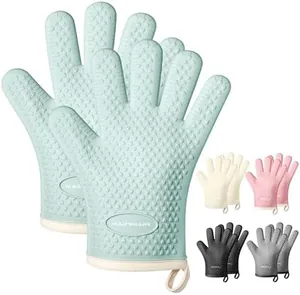
Silicone Oven Mitts with Fingers Heat Resistant 450°F in Ki…
Fingered silicone oven mitts rated to 450°F, with a textured grip, waterproof shell and a breathable cotton liner inside.
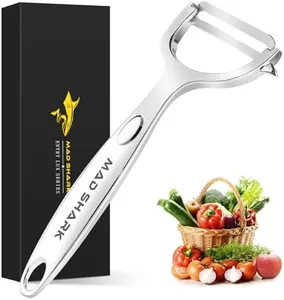
Vegetable Peeler
The Y-peeler that made our tools famous: 304 stainless serrated swivel blade, zinc-alloy body, potato-eye remover and a 3-year warranty.
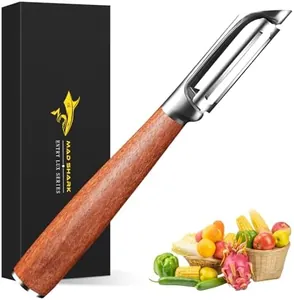
Peels Smoothly Wooden Vegetable Peeler for Kitchen
The wooden-handled peeler: natural mahogany grip, 1 mm-thick 304 stainless swivel blade, and no-clog peeling that spares the nutrients.
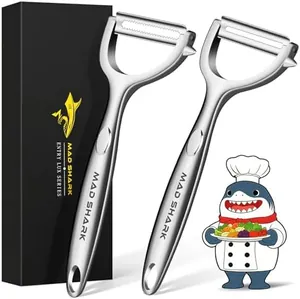
Potato Peeler 2 Pack
Two peelers, two blades: a flat edge for orchard fruit and a serrated one for slick skins, both in 304 stainless on zinc-alloy bodies.
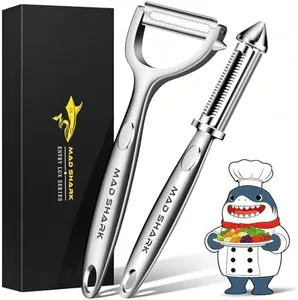
Y & I Vegetable Peeler 2 Pack
The Y-and-I pair: one Y-frame peeler and one straight, sharing flat and serrated 304 stainless blades — geometry for every grip.
Match the edge to the job
Every blade geometry in the range exists for a reason. Find your job in the left column.
| The job | The tool | Why this one |
|---|---|---|
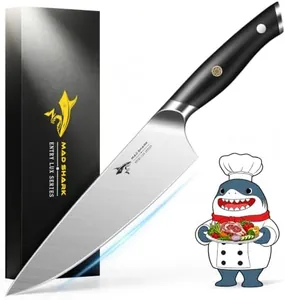
| Everyday prep | 8-Inch Chef Knife | Onions, ribeye, raw potato, tomato skin — the 15° hand-finished edge on the 8″ chef knife is the one blade that does 80% of a kitchen’s work. |
| Slicing over chopping | 8 Inch Santoku Knife | The santoku’s flatter profile and hollow-ground blade keeps sticky food — fish, rice, cucumber — from riding up the steel. |
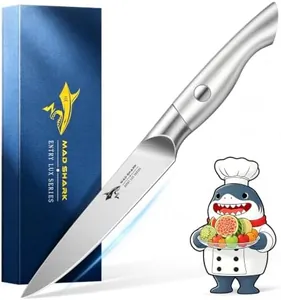
| In-hand work | Paring Knife 5 inch Ultra Sharp German Stainless Steel | Peeling, coring, segmenting citrus, garlic. Five inches of 58+ HRC steel that follows your thumb, not the board. |
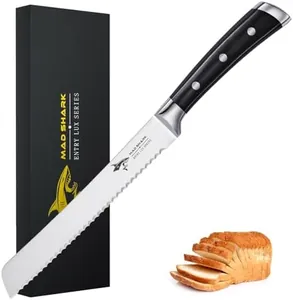
| Crust without crumbs | Bread Knife | Independent serrations saw through sourdough crust while the soft interior stays uncrushed — also the right blade for cakes and tomatoes. |
| At the table | Steak Knives | 12.6″ triple-riveted steak knives that cut plated meat cleanly instead of dragging it around the plate. |
| The smoker crowd | Brisket Slicing Knife | A curved 12″ brisket slicer pulls one long stroke through a packer brisket — no sawing, no ragged bark. |
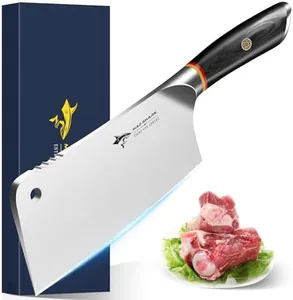
| Bone and squash | 7.5 Inch Meat Cleaver with German Military Grade Composite … | The 7.5″ cleaver in military-grade composite steel takes the jobs that would wreck a chef knife’s edge. |
| Poultry and herbs | Heavy Duty Poultry Shears | Spring-loaded shears with 3.5 mm tempered blades go through a chicken spine; the lock clicks shut one-handed in 0.2 seconds. |
Unsure where to start? One 8″ chef knife and one paring knife cover most kitchens; everything else is earned by the way you actually cook.
Stamped in the spec sheet
Every figure below is taken from the specification of a real product in the range — click through and check.
Keep it shaving-sharp
A hand-finished edge is a responsibility shared between our grinders and your sink. Three habits do most of the work.
Wash by hand, right away
High-carbon steel resents dishwashers: detergent dulls the edge and heat loosens handles. Thirty seconds of warm water and a towel straight after use is the entire routine — and it is why our own knives at the workshop still shave paper after years.
Hone weekly, sharpen yearly
A honing rod does not remove steel; it stands the microscopic edge back upright. Ten strokes a week keeps the factory 15-degree geometry alive, and a proper stone sharpening once a year resets it completely.
Board and block, never a drawer
Wood or plastic boards only — glass and stone grind an edge off faster than any amount of cutting. Between uses, a block, a magnet strip or the gift box beats a drawer where blades knock edges against forks.
Why the shark on the spine means something
A shark never stops moving, and a MAD SHARK edge is ground on the same principle: we pursue ultra-sharp on every single blade so that the effort ends at our workshop, not on your cutting board. That is the whole brand in one sentence — our great efforts, your effortless cuts. It is why the edges are finished by hand when a machine would be cheaper, why the steel is quenched in ice when air would be faster, and why every knife ships in a gift box with a three-year promise behind it.
MAD SHARK — What Hand-Finished German Steel Actually Buys You
Most kitchen knives at this price are stamped from sheet steel, machine-beveled and boxed the same afternoon. MAD SHARK takes the long road on purpose. The chef line is ground from German EN1.4116 — the same high-carbon stainless family used across professional European cutlery — then ice-quenched, a cold treatment that pushes hardness past 56–58 HRC so the edge holds its geometry instead of folding at the first bone. Last comes the step that does not scale: a person finishes each edge by hand, to 15 degrees a side on the chef knives and 14–16 degrees across the serrated and cleaver lines. The result is a blade that starts sharper than it needs to be and stays that way long enough to make honing a habit rather than a rescue.
The catalog on this site is the complete current MAD SHARK line: chef and santoku knives, sourdough-grade bread knives, restaurant-length steak knife sets, meat cleavers and curved brisket slicers, paring knives up to a Damascus-steel flagship, five-piece sets in gift boxes, and the tools that surround blade work — spring-loaded poultry shears, serrated rotating-blade peelers and heat-proof silicone mitts.
Find Your Corner of the Range
| Family | What It Covers | Start Here If |
|---|---|---|
| Chef & Santoku | 8″ chef knives, forged and hollow-ground santoku blades | You own no good knife yet — this is the first one |
| Steak & Bread | Serrated table sets of 4/6/8, sourdough bread knives | Crust, cake and plated meat keep defeating your straight edge |
| Paring | 5″ in-hand blades, four handle colors, one Damascus | Most of your knife work happens off the board |
| Cleavers & BBQ | Meat cleavers, 70°-tip Chinese cleaver, brisket slicers | The smoker or the whole bird is your weekend |
| Sets & Tools | 5-piece gift sets, shears, peelers, oven mitts | You are equipping a kitchen — or a wedding registry |
Reading a Blade Spec Like a Grinder Does
- Edge angle — lower is sharper but more delicate. 15° a side is the sweet spot where paper-slicing sharpness survives daily board work.
- HRC hardness — how long the edge keeps its shape. Around 56 the steel forgives; at 58+ it holds an edge noticeably longer between honings.
- Full tang and rivets — steel that runs the whole handle, pinned through. It is why a knife still feels tight after its thousandth wash.
- Serration — independent teeth that saw where a straight edge would crush; the reason bread and steak knives are their own category.
The Honest Trade-Offs
High-carbon steel wants to be dried after washing — leave it wet overnight and even stainless alloys can spot. Hand-finished edges are sharper than most people expect from the box, which is a feature and a warning in one sentence. And a 3.5 mm shear blade or a 70° cleaver tip earns its keep on hard jobs, not as a paperweight; buy the geometry that matches how you actually cook. Every product page on this site breaks its blade down the same way — blade, edge, handle, and what it is like in use — so you can make that call from the spec, not the photo.
What the ratings say
No invented testimonials — these are the public rating totals three of our products carry, with our own honest reading of each number.
4.7 average · 1,802 ratings
The shears carry the biggest rating count in our whole range, and shears are merciless reviewers’ territory: they either cut through a chicken spine or they do not. Nearly two thousand people saying they do is the kind of verdict no product page could write for itself.
Heavy Duty Poultry Shears →4.6 average · 1,008 ratings
A chef knife is the most personal tool in the kitchen, which makes a thousand-rating average in the high fours genuinely hard to earn — edge feel, balance and handle shape all have to land for people with very different hands. This is the blade we tell first-time buyers to start with.
8-Inch Chef Knife →4.4 average · 1,747 ratings
Mitts are rated in the worst possible moment — with a hot tray in hand. A mid-four average across seventeen hundred kitchens says the 450°F silicone does what the number promises. The score also shows honest spread: fit is personal, and we would rather show the real figure than a curated one.
Silicone Oven Mitts with Fingers Heat Resistant 450°F in Ki… →