Home / Cleavers & BBQ Knives / 7.5 Inch Meat Cleaver with German Military Grade Composite …
MAD SHARK 7.5 Inch Meat Cleaver with German Military Grade Composite Steel | Professional Bone Chopping Butcher with Heavy Duty Blade, Chinese Chef's Bone Cutting Knife for Home Kitchen & Restaurant
Cleavers & BBQ Knives

MAD SHARK 7.5 Inch Meat Cleaver with German Military Grade Composite Steel | Professional Bone Chopping Butcher with Heavy Duty Blade, Chinese Chef's Bone Cutting Knife for Home Kitchen & Restaurant

★★★★★4.5 · 260 ratings
$45.99
Buy Now

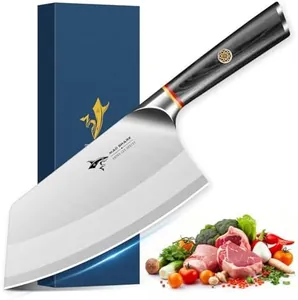
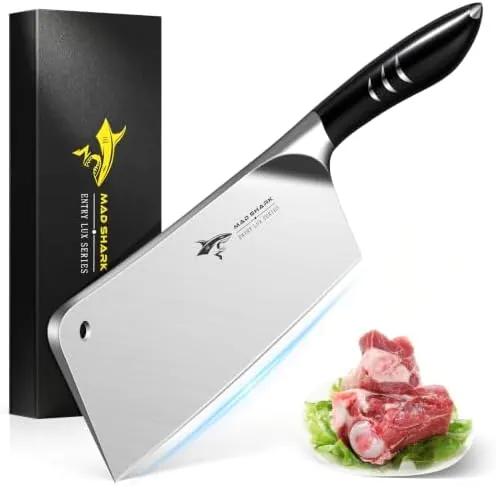
This is the one knife in our line you are supposed to hit things with. The weight does the work, 1.33 pounds swung through 3.8 millimeters of German 5CR15MOV, and the shock-absorbing hole near the spine takes the ring out of the impact when the blade stops in bone. The blade stands 3.54 inches tall, which keeps your knuckles clear of the board and turns the face into a shovel for moving what you just chopped.

Spec plate

Pattern
7.5-inch meat cleaver
Steel
German 5CR15MOV high carbon, 56+ hardness
Build
1.33 lb, 3.8 mm thick, 3.54 in broad
Construction
Full tang, ABS injection-molded handle
Care
Dishwasher safe; dry the blade after use
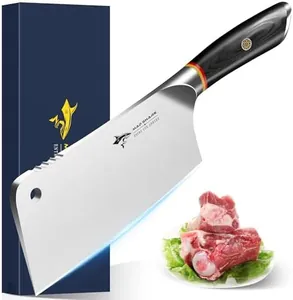
Anatomy of the tool

Blade

Mass where the chop needs it

A thin blade wedges and stops. At 3.8 millimeters and 1.33 pounds this one carries enough momentum to part a chicken joint or a beef rib in one stroke, which is safer than three tentative ones.

Edge

Heat treated, then ice water

The 5CR15MOV is hardened and cooled in ice water to 56-plus, a deliberate step below our slicing knives. A chopper wants an edge that gives a little instead of chipping when it meets bone.

Handle

ABS molded around the tang

The handle is formed by injecting ABS directly around a one-piece blade, so there are no scales to work loose. The hole in the top of the spine absorbs shock that would otherwise travel into your wrist.

In Use

Bones, poultry, and a crushed clove

Breaking down a whole bird, splitting beef bones for stock, flattening a garlic clove with the side of the blade. A butcher tool first, and a prep tool only when the prep involves force.

From the sharpening bench

Chop onto end-grain wood or thick poly, never glass or stone. The cleaver wins that argument and comes away with a flat spot in the edge.